
On This Page
The following are key clauses, relevant to ownership, precisely quoted from The Schedule in the 1976 Conveyance. The Schedule forms part of the governing document and has been treated as the instrument defining how the property is to be held on trust. The interpretations set out below reflect professional advice received in 2022.

Charity Object
1 The property hereby conveyed (hereinafter called “the Trust Property”) shall be held upon trust for the purposes of a village hall for the use of the inhabitants of the Parish of Mulbarton in the County of Norfolk (hereinafter called “the area of benefit”) without distinction of political religious or other opinions including use for meetings lectures and classes and for other forms recreation and leisure-time occupation with the object of improving the conditions of life for the said inhabitants
Relevant interpretation (based on professional advice received in 2022): This clause determines that the charity must hold property on trust, and must fulfil its object of improving conditions of life, by using that property and its income to provide Village Hall facilities. Conversely, all property used by the Charity to fulfil its object (including car park) must be held on trust.
Custodian Trustee
2. The Parish Council of Mulbarton shall be the custodian trustee of the Charity and the provisions of sub-section (2) of Section 4 of the Public Trustee Act 1906 shall apply to the said Council and to the Committee respectively in like manner as they apply to the Public Trustee and managing trustees:
Relevant interpretation (based on professional advice received in 2022): This clause establishes the Parish Council as custodian trustee in accordance with the Public Trustee Act 1906.
Section 4 of Public Trustee Act 1906:
4(2) Where the public trustee is appointed to be custodian trustee of any trust—
(a) The trust property shall be transferred to the custodian trustee as if he were sole trustee, and for that purpose vesting orders may, where necessary, be made under the Trustee Act 1925
(b) The management of the trust property and the exercise of any power or discretion exerciseable by the trustees under the trust shall remain vested in the trustees other than the custodian trustee (which trustees are herein-after referred to as the managing trustees):
Relevant interpretation (based on professional advice received in 2022): Trustees need to know what their property is, and precise boundaries thereof. Trustees are responsible for maintenance, repair, insurance and day-to-day management for whatever property is held on trust and used directly for Village Hall purposes, as specified in other sections of the Schedule. They are also responsible for managing leases where third parties are in occupation, and for applying income to Village Hall purposes.
(c) As between the custodian trustee and the managing trustees, and subject and without prejudice to the rights of any other persons, the custodian trustee shall have the custody of all securities and documents of title relating to the trust property, but the managing trustee shall have free access thereto and be entitled to take copies thereof or extracts therefrom:
Relevant interpretation (based on professional advice received in 2022): This clause provides for custody of title documents by the custodian trustee, with access for managing trustees, which ensures clarity about what property is held on trust.
(d) The custodian trustee shall concur in and perform all acts necessary to enable the managing trustees to exercise their powers of management or any other power or discretion vested in them (including the power to pay money or securities into court), unless the matter in which he is requested to concur is a breach of trust, or involves a personal liability upon him in respect of calls or otherwise, but, unless he so concurs, the custodian trustee shall not be liable for any act or default on the part of the managing trustees or any of them:
Relevant interpretation (based on professional advice received in 2022): This clause provides that the management of trust property rests with the managing trustees. The custodian trustee must concur with the directions of managing trustees, unless to do so would be a breach of trust. If managing trustees do something (or fail to do something) that amounts to a breach of trust, the custodian trustee is not liable for that, unless they actively concur with it.
(e) All sums payable to or out of the income or capital of the trust property shall be paid to or by the custodian trustee: Provided that the custodian trustee may allow the dividends and other income derived from the trust property to be paid to the managing trustees or to such person as they direct, or into such bank to the credit of such person as they may direct, and in such case shall be exonerated from seeing to the application thereof and shall not be answerable for any loss or misapplication thereof:
Relevant interpretation (based on professional advice received in 2022): The clause provides that income arising from trust property may be received by the custodian trustee but applied as directed by the managing trustees. If there are portions of property deriving income streams, there is material significance to determining trust property boundaries.
See below for details of the one instance when managing trustees exercised the power to direct spending in this way.
(f) The power of appointing new trustees, when exerciseable by the trustees, shall be exerciseable by the managing trustees alone, but the custodian trustee shall have the same power of applying to the court for the appointment of a new trustee as any other trustee:
(g) In determining the number of trustees for the purposes of the Trustee Act 1925, the custodian trustee shall not be reckoned as a trustee.
Mortgages & Charges
17. The Committee may with the consent of the Charity Commissioners from time to time by mortgage or otherwise obtain such advances on the security of the trust property or any part thereof as may be required for maintaining extending or improving the same or any part thereof or erecting any building thereon or for the work carried on therein and may continue or may repay in whole or in part and from time to time any existing mortgage or charge on the Trust Property.
Relevant interpretation (based on professional advice received in 2022): Any mortgage on Charity Property must have Charity Commission consent and be used for the charity to fund improvement/extension/replacement of Charity property.
The Charity did secure a mortgage and charge after rigorous process in 1989, when the Charity needed to pay builders for the new hall construction, using a loan from Barclays, secured on the old hall. A sealed court order provided this power, based on assurances recorded in the court documentation relating to the new hall, that it would be constructed “on land belonging to the charity”. This meant the loan could be secured against the old hall. The bank required two trustees and two Councillors to take the court order to the Wymondham branch and all sign the loan agreement in person with the court order on the table. Both Charity and Parish Council minutes record this event, as does correspondence addressed to the Parish Council.
Sale & Letting
18. If the Committee decides at any time that on the ground of expense or otherwise it is necessary or advisable to discontinue the use of the Trust Property in whole or in part for the purposes stated in Clause 1 it shall call a meeting of the inhabitants of the age of eighteen years or upwards of the area of benefit of which meeting not less than fourteen days’ notice (stating the terms of the resolution that will be proposed thereat) shall be posted in a conspicuous place or places on the Trust Property and advertised in a newspaper circulating in the area of benefit and if such decision shall be confirmed by three-quarters of such inhabitants present and voting at such meeting the Committee may with the consent of the Charity Commissioners let or sell the Trust Property or any part thereof. All moneys arising from such letting or sale (after satisfaction of any liabilities properly payable thereout) shall with such consent as aforesaid be applied either in the purchase of other property approved by the Committee and to be held upon the trusts for the purposes and subject to the provisions hereinbefore set forth (including this power) or as near thereto as circumstances shall permit or towards such other charitable purposes or objects for the benefit of the inhabitants of the area of benefit as may be approved by the Charity Commissioners and meanwhile such moneys shall be invested and any income arising therefrom shall either be accumulated (for such time as may be allowed by law) by investing the same and the resulting income thereof in like manner as an addition to and to be applied as the capital of such investments or shall be used in furthering the purposes specified in this Deed.
Relevant interpretation (based on professional advice received in 2022): Any sale/letting of protected Charity property must have 75% residents’ support, Charity Commission consent, and majority trustee support. Disposition income must be used to purchase other property for the Charity; or given to another body approved by the Charity Commission, who would carry on the charity’s purpose, after which the Charity itself would cease to exist. If a sale happens, the Charity must continue to have sufficient property to carry on its charitable activity.
The Charity did sell the Old School in 1989, and spent the proceeds of sale in full on the new hall. As with the mortgage, this required a sealed court order, which was issued on the basis of assurances made to the Charity Commission by the Parish Council, about the new property being held on trust, in the same way as the old. In addition, trustees constructed a complete audit trail of every penny spent, with reference to records from the period, which document in full the processes followed and the expenditure incurred.
In Short
There are four key clauses regarding property ownership and holding of title, where the governing document acts as a binding property instrument, relating to any title deed for land on which the charity operates.
Understanding the nature and implications of these key clauses is crucial to providing clarity about charity property.
Clause 4.2(e) in Practice – September 2022
Managing trustees have only once exercised their discretion under this clause to direct spending of some of this charity money held by their custodian trustee. This was £1,380 for a survey of the site which the Charity required in summer 2022. Based on the requirement to have a charity report from an independent surveyor before charity property can be leased, the survey was conducted to provide an independent professional valuation of the different leases on site, as well as regular hire fees and occupation licenses for social club and two nurseries. These valuations gave important independent assessments of appropriate hire, lease and license terms for users of the site, and provided trustees with a fair and defensible pricing structure, with the aim of preserving the interests of the charity, and maintaining impartiality.
As custodian trustee, the Parish Council complied with this instruction and paid that invoice. At the time of the payment to Watsons, some uncertainty remained about charity boundaries, and therefore about what income had been derived from charity property. Nevertheless, all agreed that the amount of charity money held by the Parish Council was at least equal to this invoice, and on that basis the payment was made, from funds held by the Parish Council for the Charity, as recorded in Parish Council minutes from the time:
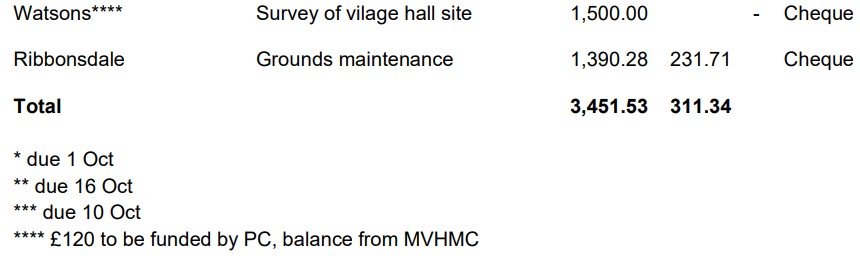
The public minutes in October 2022 recorded that this invoice was paid. The minutes from September 2022, the month before, explained the rationale. The minutes record the view of the Parish Council at that time, that the phone mast was on charity property, even though precise final agreement had not been reached. By that stage, the Parish Council had derived £104,378 from MBNL in rental, sufficient to cover the Watsons invoice.

Leave a Reply